
Artificial Wombs. AI Alloparenting. Population Collapse. Science or Fiction?
The three trends converging into Birthright’s world.


Three months ago Birthright was released to the world. Time flies.
[For the ones new here: Birthright is my latest near-future novel about a country voting to ban natural birth, and a young woman for whom it’s about to become the most personal question of her life.]
And today it’s time for something I’ve been promising you for a while: the post where I shine light on the science that shaped Birthright. A few things got in the way … finishing the first developmental edit of my third novel, SAINT, had to come first. And SAINT needs to exist before Birthright II can. So, apologies for the wait. I’m sure you understand ;)
As I’ve written in my post on worldbuilding, one of the things I care most about as a writer is the plausibility of the worlds I create. Not just “it could happen” plausibility, but the kind that makes you feel slightly unsettled — like the world in the book is already beginning to form at the edges of it. Near futures that feel close enough to touch.
To get there, I do a lot of research. And for Birthright, set in 2096, I kept coming back to three trends that — if you let yourself think them 70 years forward — have the potential to converge into something that looks very much like the world Grace inhabits. Three trends that are already underway, already accelerating, and already raising questions nobody has a clean answer to.
Fair warning: some of what follows is spoiler-adjacent, in the sense that understanding these trends tells you something about the world the novel is built on. If you haven’t read Birthright yet and want to go in completely cold, stop here.
Otherwise, read on.
I. The technology of making babies
Let me start with the one trend that feels most like fiction, even though it isn’t.
In 2017, scientists at the Children’s Hospital of Philadelphia placed a premature lamb fetus — equivalent developmentally to a 22-week human — into a fluid-filled bag. A transparent sack, connected to an artificial lung via the umbilical cord. The lamb’s blood circulated through the device, picked up oxygen, and returned. No mother. No womb. Just a bag of carefully engineered amniotic fluid, and a heartbeat.
The lamb survived. Grew. Developed.
That device is called the EXTrauterine Environment for Newborn Development — EXTEND. It was originally designed with a narrow, compassionate purpose: to give the very smallest premature infants a few more weeks of development before they face the outside world. The FDA was already discussing moving it into human trials as of 2023, with the technology having been tested on around 300 lamb fetuses with strong results. This isn’t speculative. This is the near-term pipeline.
But here’s where it gets interesting for a novelist.
The researchers who invented EXTEND themselves called full ectogenesis — a baby gestated entirely outside the human body, from conception to birth — a “technically and developmentally naïve pipe dream.” And they’re probably right, at least for now. The conversation between a fetus and its mother’s body is extraordinarily complex: hormones, immune signals, chemical exchanges we don’t fully understand yet, let alone replicate. The ethical framework governing embryo research — most countries prohibit experimenting on embryos beyond 14 days — has meant that the two ends of the ectogenesis timeline (early embryo development and late fetal development in artificial environments) haven’t yet been able to meet in the middle.
But notice the language there: ethics, not technology, as the limiting factor. Scientists at Cambridge already grew a human embryo in vitro for 13 days before stopping — not because they couldn’t go further, but because they weren’t allowed to. And meanwhile, in Japan and in Silicon Valley, researchers are racing to create viable eggs and sperm entirely from adult skin cells — a technology called in vitro gametogenesis. The developmental biologist Katsuhiko Hayashi predicted in 2025 that functional human gametes from skin cells are perhaps five to ten years away. A startup called Conception — backed by Sam Altman, among others — is pursuing this explicitly as a way to break through the biological barriers for having children.
Think about what these threads look like, combined, in 70 years. That’s what I was doing when I built the world of Birthright.
There’s also embryo selection — which already exists today, quietly. Companies are now offering polygenic embryo profiling: identifying which of your IVF embryos might have a slightly higher IQ, or be taller, or less susceptible to certain diseases. Most scientists are deeply skeptical about the predictive accuracy of these claims. But the direction of travel is clear. The fertility clinic of 2096 looks very different from the one of 2024, and it already looks quite different from the one of 2004.
If you want to go deeper on where reproductive technology is right now, MIT Technology Review has a particularly clear explainer on artificial wombs, and the MIT Press Reader has a longer piece on the full arc of fertility tech — from sperm banks to ectogenesis — that’s worth your time.
And if you feel like something more visual, the futurist Hashem Al-Ghaili has created an entire video called EctoLife: The World’s First Artificial Womb Facility, making future large-scale artificial birthing centers and their operations feel real today.

II. The way we’ve always raised children (and the way we forgot)
This one is less viscerally dramatic, but I find it almost more unsettling, because it’s about something we take completely for granted.
The nuclear family — two parents, their children, a private home — feels like the natural, default unit of human life. It isn’t. It’s actually a relatively recent historical experiment.
For most of human evolutionary history, children weren’t raised by two parents in isolation. They were raised by groups. Anthropologists call the non-parent carers alloparents — grandmothers, aunts, uncles, older siblings, trusted members of the community who shared in feeding, carrying, and protecting children. The evolutionary anthropologist Sarah Blaffer Hrdy — who also happens to have a great TED talk on robots raising babies — has argued persuasively that this cooperative breeding strategy may be the secret of human cognitive success: our unusually large brains and social empathy may have been selected for precisely because we needed to read the intentions of all these different carers, to navigate complex multi-adult relationships from the very beginning of life.

The nuclear family as we know it solidified largely in the 19th and 20th centuries, with industrialisation and urbanisation pulling families apart from their wider kin networks. And even then, the experiment was fragile. David Brooks wrote a widely-read piece in The Atlantic in 2020 arguing that the nuclear family was a mistake — or at least, a historically anomalous structure that works reasonably well for the wealthy and is quietly devastating for everyone else. Without the extended network, if one parent dies or leaves or simply struggles, there’s nothing to catch the child. The village, quite literally, is gone.
About 38% of people globally still live in extended family households. In much of Asia, the Middle East, and Africa, multi-generational living remains the norm. The idea that two people, alone, should be fully responsible for a child’s emotional, cognitive, moral, and physical development is — from a deep-time perspective — a strange ask.
This matters for Birthright because one of the questions the novel is sitting inside is: what happens when technology allows us to revisit that assumption? When AI can support professionals to play the role that alloparents once served — not replacing human love and connection, but filling in some of the bandwidth that the modern isolated nuclear family is constantly running short of?
Which brings me to Alpha School. It’s a private school in Austin, Texas, where students spend two hours a day on AI-driven personalised instruction — and consistently score in the top 1% of standardised tests nationally. The rest of the day is project-based and social. There are no lectures. Kids don’t move forward until they’ve actually mastered the material, not just sat through it. The principal, Joe Liemandt, has made the argument on Shane Parrish’s Knowledge Project podcast that the traditional classroom was designed for a very narrow band of learners and wastes nearly everyone else’s time. His bet — a billion-dollar one — is that AI can help children learn ten times faster.
You could dismiss that as Silicon Valley optimism. But the underlying logic — that AI-driven, adaptive, one-to-one instruction could dramatically outperform a teacher managing 30 children at once — is genuinely hard to argue with. And it’s only a few steps from there to asking: if AI can teach better, what else of the parenting function might it eventually handle? And what do we lose, or gain, if it does?
The Atlantic ran a piece in 2025 called “AI Is Coming for Parents“ that captures this ambivalence really well. It’s partly funny — there are AI party planners for kids’ birthdays, a robot called Snorble that soothes children in the night so their parents don’t have to wake up — and partly genuinely troubling, in the way that the most interesting technological developments tend to be.
III. The population crisis you’re not feeling yet
This is the trend I find most comparable to climate change: slow-moving, poorly understood by most people, and by the time it becomes viscerally undeniable, essentially too late to easily reverse.
Here come some numbers worth sitting with. The graphs were inspired by Derek Thompson’s latest interview with population expert Jesús Fernández-Villaverde. Which included not just great graphs, but plenty of unforgettable facts such as: If Thailand will have a fertility rate of 0.8 for two centuries, you don’t close some hospitals, you close 98% of them.
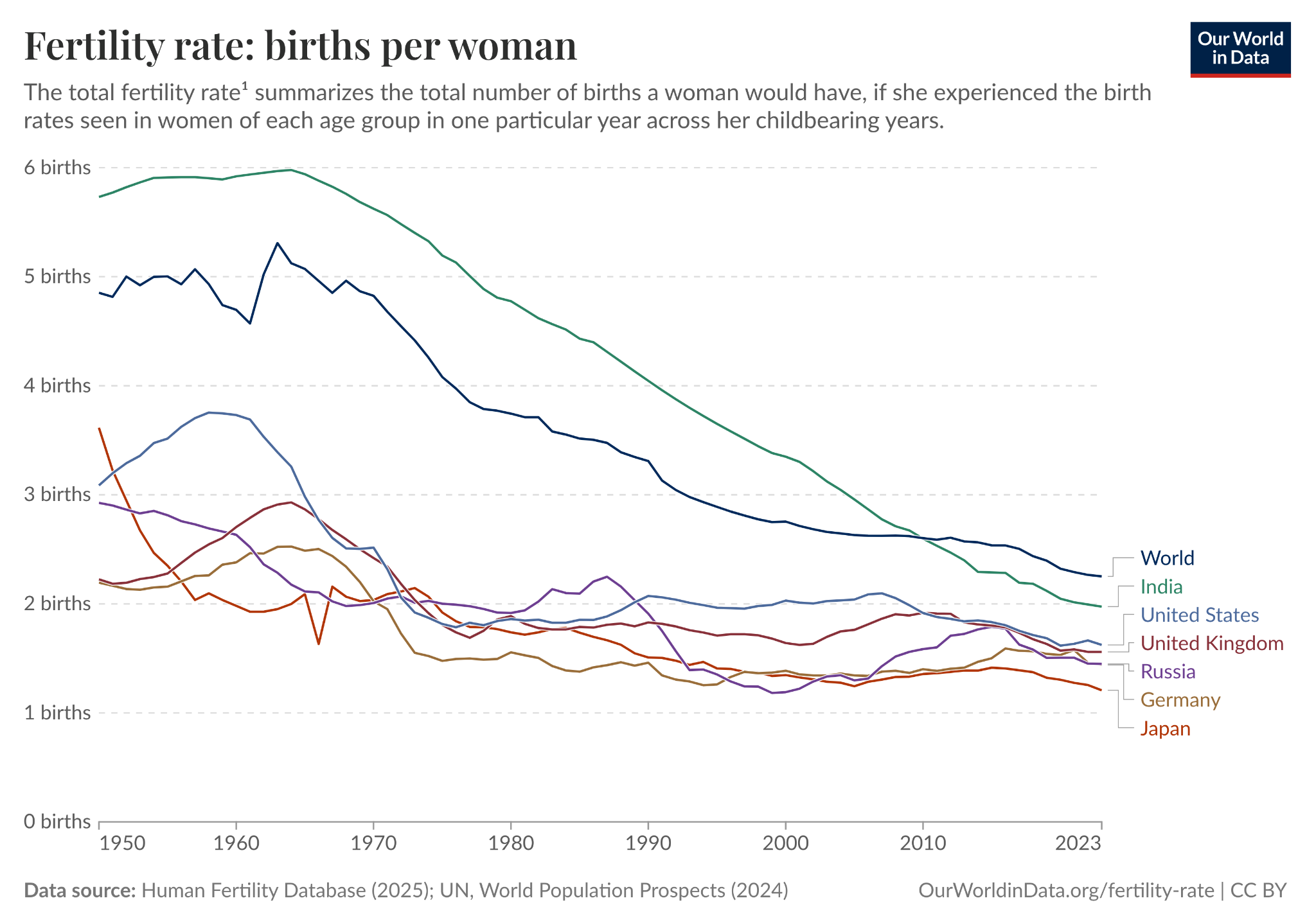
The birth rate required for a population to remain stable — not grow, just stay the same — is 2.1 children per woman. South Korea is currently at around 0.72. Colombia and Chile have fallen to around 1.0. The EU average is 1.34. And the United States, once an outlier for its relatively healthy fertility rate, has seen it drop nearly 25% since 2008 to 1.57 in 2025. Africa remains the last region with above-replacement fertility, but even there rates are declining faster than demographers predicted. Noah Smith, an economist, has written compellingly about this on Noahpinion: no one on the entire planet knows how to stop this trend. And he explicitly compares dismissing population decline to dismissing climate change — both are slow enough to ignore until they can no longer be ignored.
The comparison isn’t just rhetorical. Like climate change, the real damage happens across a long timeline. You don’t feel a declining birth rate in the same way you feel a recession or a pandemic. What you eventually feel is a society that’s simultaneously older and smaller — fewer workers, a shrinking tax base, more retirees, less innovation, more strain on healthcare systems, failing infrastructure too expensive to maintain for a few, and at the end collapsing economies with all the geopolitical implications. Japan is already experiencing this. South Korea will follow. Most of Europe is heading in the same direction.
And here’s the part that keeps me up at night as a writer: the solutions we’ve tried don’t really work. Hungary introduced some of the most aggressive pronatalist policies in history — women with four or more children pay no income tax for life, among other incentives. South Korea has spent an estimated $200 billion over two decades on various programmes. Birth rates have barely moved. The Economist published a characteristically clear-eyed piece on this in 2024, arguing that most pronatalist policies have only marginal effects on fertility — because the underlying causes aren’t about money. They’re about what modern life costs in time, energy, identity, and opportunity cost.
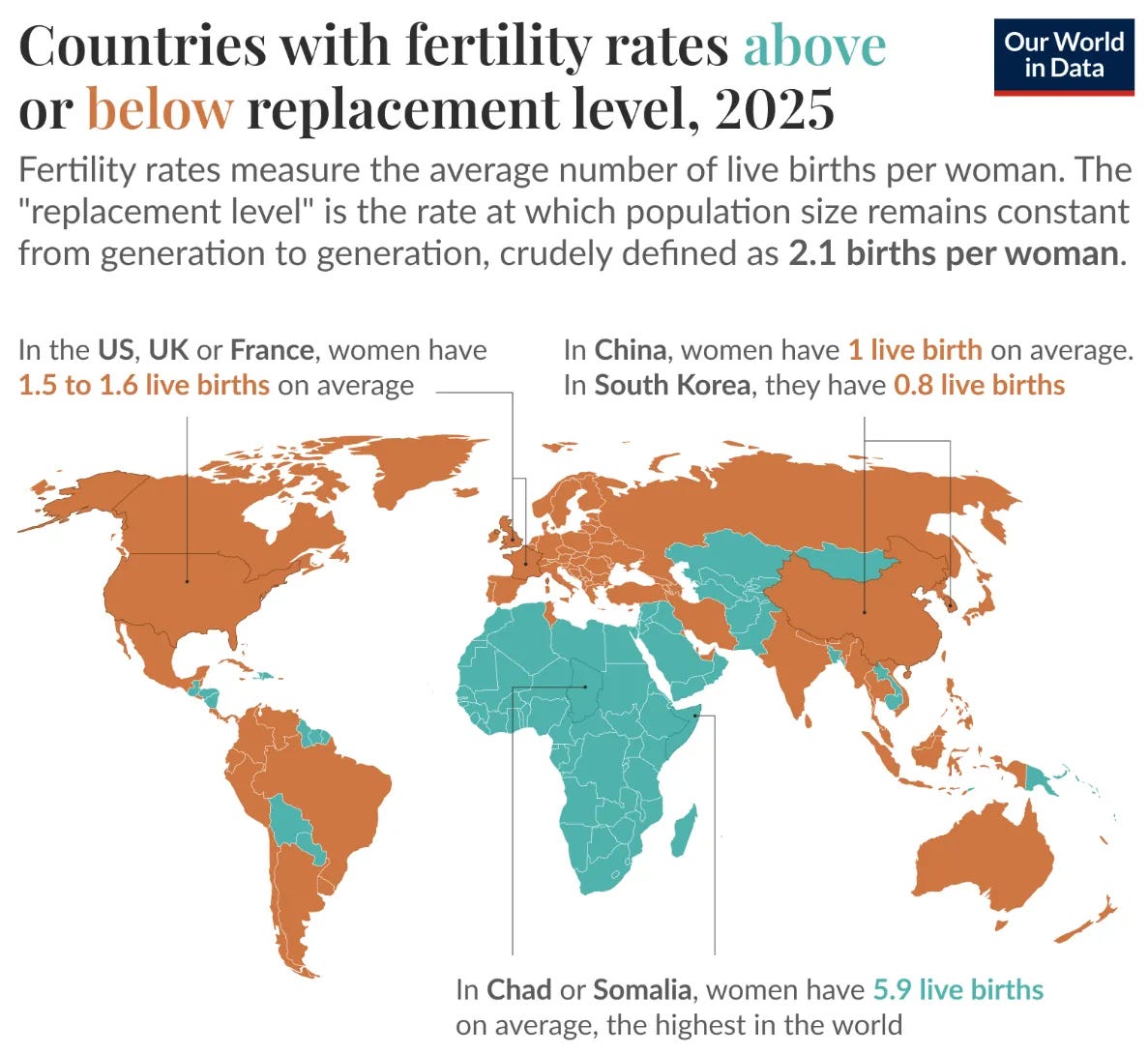
So what happens in 70 years, if that trend continues and nothing has worked?
That’s the backdrop of Birthright. Not a background detail — the entire premise of the novel rests on what a society might be willing to do when it feels existential pressure around its own survival. When a baby isn’t just a bundle of joy but a small act of economic survival.
Putting it together
Here’s what I find genuinely fascinating, and genuinely frightening, about all three of these trends.
They’re pointing in the same direction.
Reproductive technology is advancing toward a world where gestation can happen outside the human body. Parenting models are under strain in ways that make communal and AI-assisted childcare feel less like dystopia and more like practical necessity. And demographic pressure is building quietly, with no policy solution yet found, toward a point where societies may feel they need to do something dramatic.
I didn’t invent the world of Birthright. I projected it. Took threads that already exist, followed them forward, and asked: what does this feel like to live inside?
That’s what I hope the novel does for you — not terrify you, but make you feel the weight of these questions in a way that abstract statistics can’t. Fiction, at its best, is a way of experiencing a possible future before it arrives. A rehearsal for questions we’ll actually have to answer.
I’d love to know which of these three futures are you most willing to accept — and which one are you hoping we never have to?
And also tell me if you enjoyed this little science-behind-the-book piece, or rather have me stick to writing fiction and the journey of doing so :)
Until next time, keep reading. Always keep reading.
Max
PS — On June 1st is World Parents Day. To celebrate every parent and parent-to-be reading this, I’ll make the Birthright ebook available for free on Amazon. Amazon now also allows you to download it as a PDF or EPUB, so you can share it with whoever you think it might resonate with 🙂
PPS — If you have already read Birthright, but haven’t left a review on Amazon yet, please do so. A short review makes more difference than you’d expect and helps this book reach the readers it was made for.
Further reading:
Everything You Need to Know About Artificial Wombs — MIT Technology Review
The Future of Fertility Technology — MIT Press Reader
Womb for Improvement — Works in Progress
The Birth-Rate Crisis Is Even Worse Than You’ve Heard — The Atlantic
The Global Fertility Crisis Is Worse Than You Probably Think — Derek Thompson
Nobody Knows How to Stop Humanity From Shrinking — Noahpinion
The Nuclear Family Was a Mistake — The Atlantic
There Is a Better Way to Parent Than the Nuclear Family — Aeon
AI Is Coming for Parents — The Atlantic
Joe Liemandt on Alpha School — The Knowledge Project
Parenting as a Public Good — Works in Progress
Why the World’s Population is Heading for Collapse - Economist Youtube
If you haven’t subscribed yet, you’re very welcome to — it helps this newsletter find the readers it’s meant for.
And if you are already subscribed, feel free to share this with just one person who you think might genuinely enjoy it.